
Double Solenoid System
"Parameter No. 9 Electromagnetic Valve System" is to be set to "Double".
Home return operation/positioning operation: "ST0", "LS0", "ST1", "LS1" signals
Turning the "ST0" signal ON when home return is not complete will first trigger home return operation.
After a momentary stop at the home position, it will then move to the backward end. As well, when the "ST1" signal is turned ON, the unit will move to the forward end after home return operation. However, for battery-less absolute encoder specification, the positioning operation should be conducted without having the home return operation.
After a momentary stop at the home position, it will then move to the backward end. As well, when the "ST1" signal is turned ON, the unit will move to the forward end after home return operation. However, for battery-less absolute encoder specification, the positioning operation should be conducted without having the home return operation.
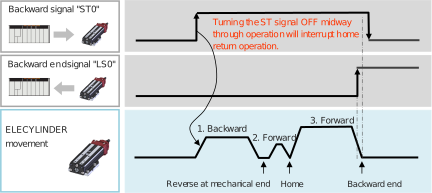

Operation Behavior While Home-Return Operation (When "ST0" Signal is Used)
- When the "ST0" signal is turned ON, backward motion begins towards the mechanical end.
The movement speed is 20mm/s. - Once the mechanical end is struck, the direction will be reversed and forward motion will begin.
The unit will move forward until the home position, then stop. - After that, it will continuously move forward until the backward end, where it stops as operation is complete.
Caution
- In the home reverse specification (model: NM), home return operation is in the reverse direction.
This shows the PLC timing chart for operating the ELECYLINDER.
The basic process is as follows.
The basic process is as follows.

[Basic timing chart]
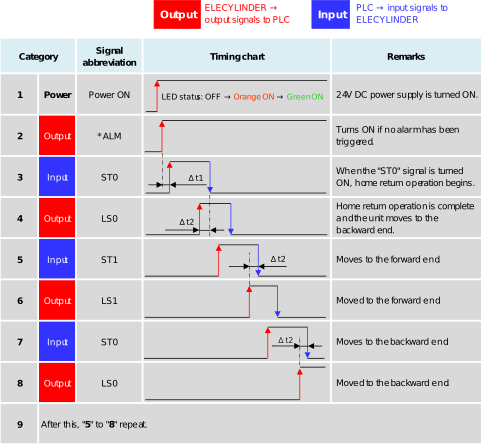
Δt1: Wait approximately 0.5 seconds from when the "*ALM" signal turns ON before inputting the first command.
Δt2: The time taken for the ELECYLINDER actually to reach the forward or backward end after the LS signal turns ON. Consider Δt2 when giving instructions for the next operation from the PLC to the ELECYLINDER.
Δt2 becomes longer for larger detection ranges.
Δt2 also changes with the size of the transported load and acceleration/deceleration speeds.
Δt2 becomes longer for larger detection ranges.
Δt2 also changes with the size of the transported load and acceleration/deceleration speeds.
Turning the ST signal OFF midway through operation will cause a gradual stop.
For example, be careful of the following point with a large LS signal detection range.
For example, be careful of the following point with a large LS signal detection range.
If the sequence is set to turn the ST signal OFF immediately after the LS signal turns ON, the moving parts may not have reached the forward/backward end.
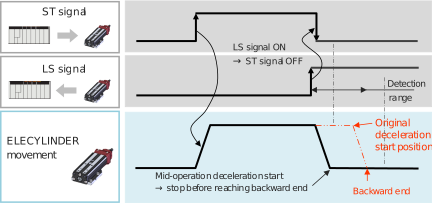
Caution
- Turning the "ST" signal ON again after the gradual stop causes the ELECYLINDER to begin operation again.
- Within the detection range, the LS signal turns ON even if the ELECYLINDER is midoperation.
- Make sure that "ST0" and "ST1" do not turn ON simultaneously.
"ST0" Signal should be prioritized when both are turned ON at the same time, and "ST0" Signal should get input.
Pressing operation: "ST0", "ST1", "PE0", "PE1" signals
Before conducting pressing operation, refer to Pressing Operation Setting and configure the operating conditions and position settings using the Simple Data Setting screen.
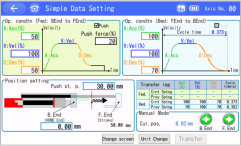
The basic time chart is as follows.
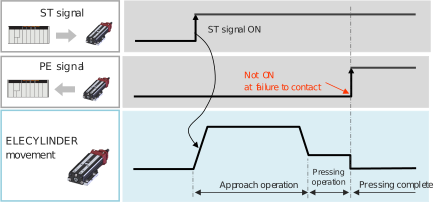
Caution
- The pressing operation speed may vary depending on models.
- The workpiece remains pressed after the pressing is completed. If the workpiece moves or pushes back, it may be pressed even further.
- Have ST Signal kept on at the pressing complete. Turn it off and the pressing operation should not perform.
- When the actuator hits a workpiece during approaching operation, any of alarm or pressing complete signal would be output but pressing operation should be continued.
- When stop after miss-pressing, the actuator should move to the position set in the operation range tuning in the parameter at the forward end, and should move to 0mm at the backward end.
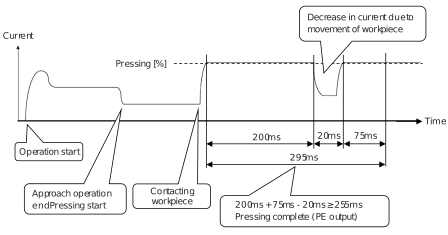
The torque (current limit value) configured for "Pressing force" in the Simple Data Setting screen judges completion of pressing operation.
When the ELECYLINDER is performing pressing operation, satisfying the following conditions will produce a judgment of pressing complete, turning ON the PE signal.
"Accumulated time in which current has reached pressing value [%]" – "Accumulated time in which current is less than pressing value [%]" ≥ 255ms
Reference
Reference
Here are some caution for when operation to the forward end or backward end is terminated with a miss-pressing.
Consider a master device sequence or detection method based on the content below.
- PE Signal should not turn on when there is a miss-pressing. It is necessary to make a judgment whether miss-pressing was happened or not with using such a tool as a timer.
- After a miss-pressing, the pressing current should retain and positioning stop.
There may be an error occurred when an actuator is pushed back due to external force. - If the workpiece shifts once pressing complete is determined and the PE signal is ON, the ELECYLINDER will start another pressing operation with the PE signal still ON.
If the workpiece cannot be pressed again, it will remain ON even with no contact.
2-circuit power supply specification TMD2 (Option)
The 2-circuit power supply specification is capable of supply the motor power (drive source) and the control power individually.
Select the 2-circuit power supply specification (TMD2) when it is required to cut the drive power source off without keeping the control power supply to ELECYLINDER not turned off.
Refer to Pulse Motor Equipped Models Wiring and 200V AC Servomotor Equipped Models Wiring.
Select the 2-circuit power supply specification (TMD2) when it is required to cut the drive power source off without keeping the control power supply to ELECYLINDER not turned off.
Refer to Pulse Motor Equipped Models Wiring and 200V AC Servomotor Equipped Models Wiring.
Here shows the timing chart of when the 2-circuit power supply specification (TMD2) is selected.
Pulse motor equipped models
- At startup (Encoder: For WA specifications)
- The absolute reset is to be completed already.
- It is to be a state of being at the backward end when the power is turned on.
(In range of Parameter "Auto Switch "LS" Signal Detection Range Adjustment [mm]")
[Timing chart]
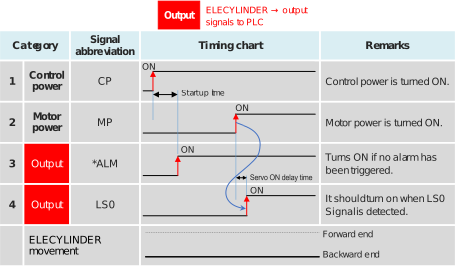
* LS Signal would not turn on before the initial servo on when it is the battery-less absolute type and also TMD2 type at the same time.
* The servo-on latency should differ depending on the model.
* The servo-on latency should differ depending on the model.
- Move to forward end (Cut of motor power supply during operation)
- The absolute reset is to be completed already.
- It is to be a state of being at the backward end after the power is turned on.
(In range of Parameter "Auto Switch "LS" Signal Detection Range Adjustment [mm]")
[Timing chart]
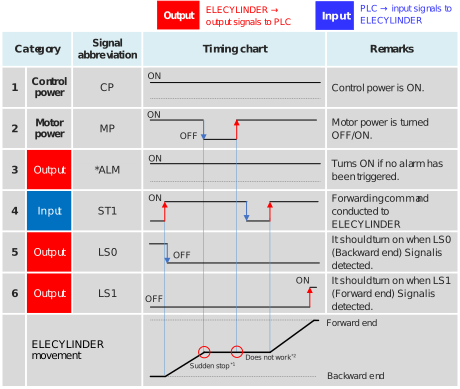
*1 A sudden stop should be made by the emergency stop torque. The distance of movement at sudden stop should be the stop distance when an actuator stops at the maximum deceleration speed from the operation velocity just before the motor power gets turned off or less.
When the drive power supply is cut off, it should come to "stop Signal: Motor voltage Drop" without generating an alarm.
When the drive power supply is cut off, it should come to "stop Signal: Motor voltage Drop" without generating an alarm.
*2 ELECYLINDER would not operate after the motor power cutoff even if the motor power gets supplied again while the forward signal (ST1) or backward signal (ST0) is on.
In case of making it operated, it is necessary to turn either ST1 or ST0 off and turn it back on.
In case of making it operated, it is necessary to turn either ST1 or ST0 off and turn it back on.
200V AC servo motor equipped models
- At startup (Encoder: For WA specifications)
- The absolute reset is to be completed already.
- It is to be a state of being at the backward end when the power is turned on.
(In range of Parameter "Auto Switch "LS" Signal Detection Range Adjustment [mm]")
[Timing chart]
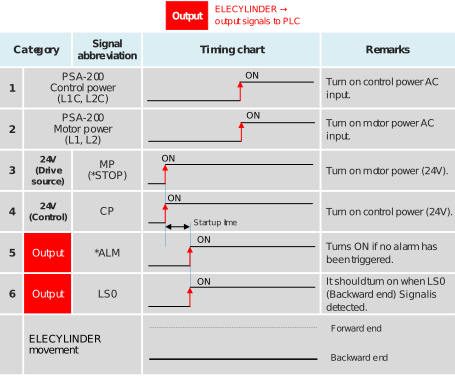
- Move to forward end (cutting off 24V (drive source) and motor power supply (L1 and L2) during operation)
- The absolute reset is to be completed already.
- It is to be a state of being at the backward end after the power is turned on.
(In range of Parameter "Auto Switch "LS" Signal Detection Range Adjustment [mm]")
[Timing chart]
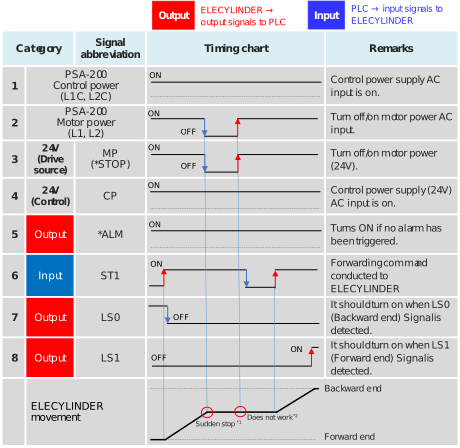
*1 A sudden stop should be made by the emergency stop torque. The distance of movement at sudden stop should be the stop distance when an actuator stops at the maximum deceleration speed from the operation velocity just before the motor power gets turned off or less.
It should come to "stop Signal: Stop" without generating an alarm.
It should come to "stop Signal: Stop" without generating an alarm.
*2 ELECYLINDER would not operate after the motor power cutoff even if the motor power gets supplied again while the forward signal (ST1) or backward signal (ST0) is on.
In case of making it operated, it is necessary to turn either ST1 or ST0 off and turn it back on.
In case of making it operated, it is necessary to turn either ST1 or ST0 off and turn it back on.
Caution
- ELECYLINDER would not stop suddenly when only motor power supply (L1 and L2) is cut off.
Cut the "24V (drive source)" off at the same time.