
Troubleshooting Diagnosis (for Models with Pulse Motor Equipped)
If a problem occurs, check the following points first in order to ensure quick recovery and prevent recurrence of the problem.
Shown below, is having the EC-T3□ (Ultra Mini ELECYLINDER) as an example.
The LED display at any trouble being occurred is in common for all the pulse motor equipped models.
Refer to an instruction manual of each ELECYLINDER for the position of LED lamps.
Shown below, is having the EC-T3□ (Ultra Mini ELECYLINDER) as an example.
The LED display at any trouble being occurred is in common for all the pulse motor equipped models.
Refer to an instruction manual of each ELECYLINDER for the position of LED lamps.
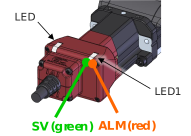
- Check LED1 (Servo / Alarm)
e.g.) SL3□/GDS3L/GDB3□/T3□

○: Light ON, ×: Light OFF, ★: Blinking
LED1 (Servo / Alarm) | Operation status | *ALM signal (*1) output status | |
|---|---|---|---|
SV (green) | ALM (red) | ||
× | × | Power OFF, Servo OFF | OFF |
× | ○ | Alarm generated | OFF |
Stop switch ON (When using teaching pendant) | ON | ||
○ | × | Power ON, Servo ON | ON |
★ (Green 500ms ⇔ Red 500ms alternate blinking in 1 Hz cycle) | Maintenance warning generated (When the travel count or the travel distance has exceeded the set value, or when overload warning is generated) | ON | |
★ (Blinking in green, 1000 ms, 0.5 Hz frequency) | × | In process of automatic servo OFF | ON |
○ (both green and red ON) | Initializing when power comes ON | OFF | |
*1 *ALM Signal is a signal of the break contact output.
e.g.) SL3□/GDS3L/GDB3□/T3□
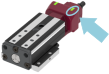
- Check LED2 (wireless)
e.g.) SL3□/GDS3L/GDB3□/T3□
○: Light ON, ×: Light OFF, ★: Blinking
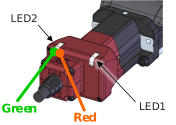
LED2 (Wireless) | Wireless status | |
|---|---|---|
Green | Red | |
× | × | Wireless hardware initializing Wireless not connected (transmitting monitor data) Connecting from wired teaching pendant |
× | ★ (ON 200ms/OFF 200ms alternate blinking) | Wireless hardware error |
★ (ON 150ms/OFF 150ms alternate blinking) | × | Connecting through wireless |
e.g.) SL3□/GDS3L/GDB3□/T3□
- Check for abnormality in the master device (PLC, etc.)
- Check the voltage of the main power supply (24V DC)
Check for momentary power failure, voltage drop, power failure, etc. - Confirm the generated alarm
Check the alarm information with the teaching tool. - Check the connectors for disconnection or incomplete connection
- Check the cables for connection error, disconnection or snagging
Cut off the main power supply of the equipment (to avoid electric shock) and remove the cables around the measurement point (to avoid conductivity through the surrounding circuit) before checking the conductivity. - Check the I/O signals
Use the master device and ELECYLINDER teaching tool to check for inconsistency or abnormality in the input/output signal status of the two units. - Check the noise elimination measures (grounding, connection of noise suppressor, etc.)
- Check the events leading to the occurrence of the problem, as well as the operating conditions at the time of occurrence
- Analyze the cause
- Countermeasures
Caution
- When troubleshooting, exclude normally functioning parts from the targets to narrow down the causes.
- First, check 1. to 10. so that countermeasures can be taken swiftly.